Staining or Painting Brick in an Indianapolis Historic District
Not without asking first. In a local historic district, the Indianapolis Historic Preservation Commission (IHPC) treats painting, staining or coating brick that has never been painted as work that needs a Certificate of Appropriateness. Get that approval before any color goes on the wall.
The short answer: in an IHPC district, stain and paint go through the same door. Unpainted brick needs the hearing officer's approval for either one, and a coating the commission finds non-breathable goes to a full commission hearing. Call IHPC staff before you settle on a color.
Our page on brick staining in Indianapolis covers the city as a whole. This post covers the local historic districts, where a city commission reviews changes to the outside of a house before they happen. Every rule below is quoted from the commission's own documents.
Do I need permission to stain or paint brick in an Indianapolis historic district?
Yes, if the brick has never been painted. The IHPC's policies, adopted January 8, 2025, list "painting, staining or otherwise coating previously unpainted masonry surfaces" as work for the hearing officer. That means an application, notice to the public, and a hearing. The policies say those hearings are usually held weekly.
Stain does not get a pass for not being paint. The same policy defines painting as "any application of colored or transparent paints, stains, or sealants." So in the commission's book, a mineral stain and a can of latex start in the same line.
Some district plans skip review of paint colors. That does not cover your brick. The policy says so in a note: "painting unpainted masonry is not exempt."
Which neighborhoods does this apply to?
The local historic districts the IHPC oversees. The Encyclopedia of Indianapolis names them, among them Lockerbie Square, the Old Northside, Irvington, Woodruff Place, Herron-Morton Place, Fletcher Place, Fountain Square, and Chatham Arch and Massachusetts Avenue. The commission was established in 1967. If you are not sure your street is inside a district line, ask. The policies tell owners to contact the IHPC office whenever there is a question about whether a certificate is needed.
Conservation districts, such as Cottage Home and Ransom Place, are lighter. The Encyclopedia says a certificate there is only required for major new construction or demolition. Every area has its own preservation plan, though, and the IHPC notes that some of its policies change with the plan. Read yours before you assume.
What does the IHPC look for in a coating on brick?
Whether the brick can still breathe. Under the same policy, "permanent coating systems with chemical properties determined to be non-breathable" skip the hearing officer and go to the full commission, which usually meets monthly. A film that traps water inside old brick is exactly what that rule is there to catch.
Paint forms a film on the face of the brick. The mineral stain we apply does not: the color goes into the brick instead of onto it, and no film is left on the surface. The Brick Industry Association says mineral-based stains are "preferred due to their high water vapor permeability." Still, whether a product counts as breathable is the commission's call, not ours. Bring the data sheet and let them read it. The difference between the two is laid out in brick staining vs painting.
Can I seal brick in a historic district?
Only a small area, and only after the leak is fixed. IHPC staff can approve a clear sealer "if all other sources of water infiltration have been corrected, and the sealing agent is limited to only the affected area." A sealer across a whole wall is not staff-level work.
The Woodruff Place preservation plan is plainer still. It lists "waterproof and water repellent coatings" as not recommended, because "they are generally not needed and can potentially cause serious damage to the masonry." Our own warranty points the same way. If anyone seals over the stain, the warranty is void.
What does the Woodruff Place plan say about coloring brick?
It leans against it. The plan, adopted by the IHPC in 2001, lists "painting any previously unpainted masonry surfaces" as not recommended in its voluntary guidelines on paint colors. Read next to the IHPC's definition of painting, that line reaches stain as well. If your house is in Woodruff Place, go in knowing the plan favors leaving unpainted brick its own color.
The plan also warns against "sandblasting, high-pressure water blasting (over 600 psi), grinding, and harsh chemicals" on masonry. Keep that in mind before anyone brings a pressure washer to your wall.
My brick is already painted. What are my options?
You have more room here than with bare brick. Under the IHPC's policies, repainting with no change in color scheme needs no certificate. A new color scheme needs staff approval. Sample patches on brick that is already painted need no certificate, as long as each color scheme is no more than 25 square feet.
Getting the paint off is harder. Stain only goes onto brick that absorbs, so on a painted house the paint has to come off before any stain can go on. In a district, the removal method gets a close look. The policies leave "any abrasive cleaning process such as sandblasting or waterblasting" out of the cleaning allowed without a certificate. Woodruff Place's plan goes further: on painted masonry, "it is usually advisable to repaint after removing all loose paint," because "methods which attempt to remove all evidence of old paint can damage the masonry." That matches what we tell people outside the districts too. Stripping brick has real risks, and removing paint from brick walks through them. Talk to IHPC staff about the method before anyone starts.
What goes into an application to stain brick?
Photos and product information. The Herron-Morton Place neighborhood's guide to the process says documentation "will usually need to be submitted along with the application," including "photos of the area where work is to be done" and "product literature, product samples, or color samples." For a stain, that means the technical data sheet and the color you want.
One thing to ask about before you start: the sample. We put a sample panel on your own wall before any job, so you can see the color in your own light. The IHPC's sample patch rule names brick that is already painted. It says nothing like that for unpainted brick. So ask staff before even a small sample goes on a wall that has never been colored. Where a policy is unclear, the IHPC's administrator decides what kind of approval the work needs.
How does stain hold up on Indianapolis brick?
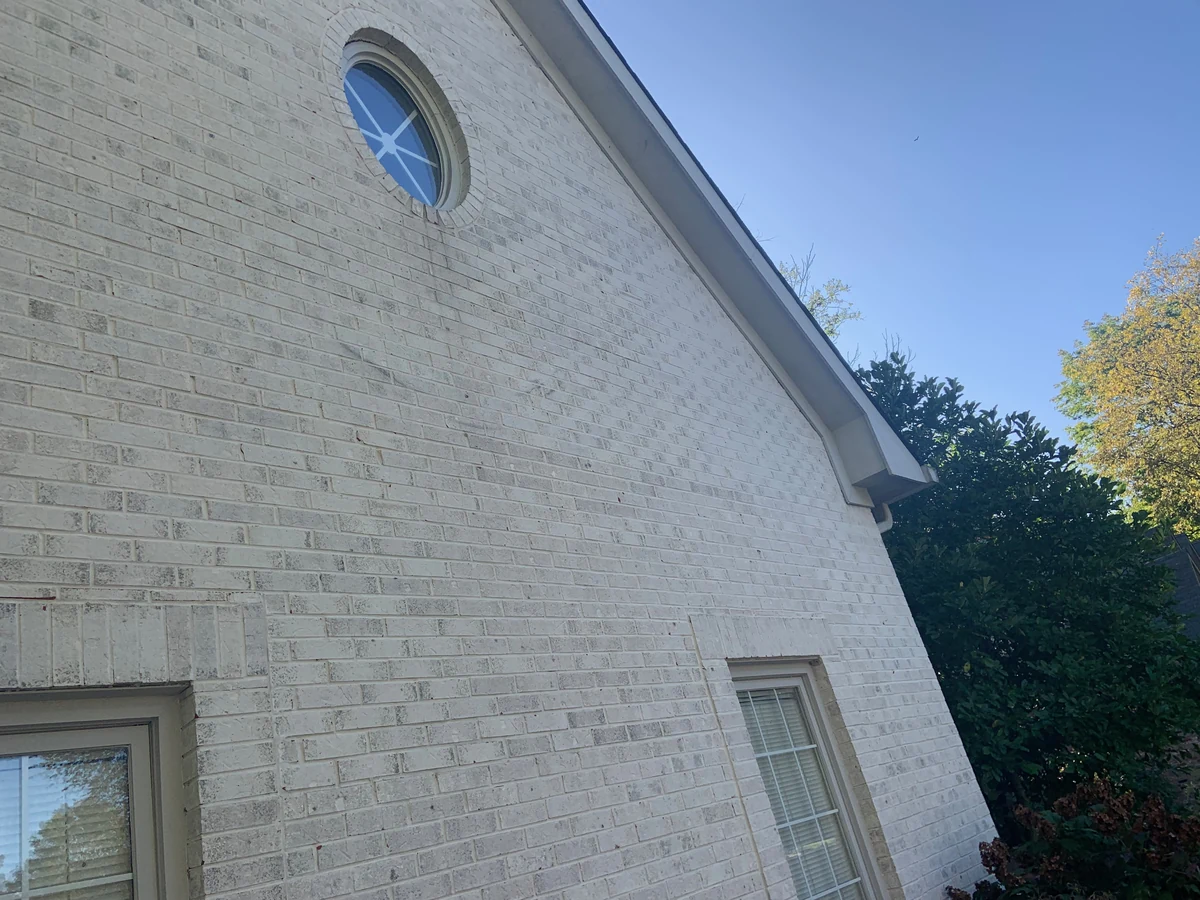
The color stays in the brick. The house in the photo is Case File 308, an Indianapolis home whose bare white brick was stained in June 2000 to blend it into the rest of the wall. It was photographed again in 2019, nineteen years later, and the wall still reads as one range. The stain we apply carries a lifetime warranty, in writing, that transfers to the next owner. In a historic district, the steps just come in a different order: the commission first, then the color.
Common Questions
Does stain count as paint to the IHPC?
Yes. The IHPC's policies define painting as "any application of colored or transparent paints, stains, or sealants." Staining brick that has never been painted needs a Certificate of Appropriateness from the hearing officer, the same as painting it.
Can I repaint brick that is already painted in an Indianapolis historic district?
Yes, if the colors stay the same. Under the IHPC's policies, repainting with no change in color scheme needs no certificate, and a new color scheme needs staff approval. Taking the paint off is a separate question, and abrasive methods such as sandblasting are not on the list of work allowed without a certificate.
Do conservation districts like Cottage Home need approval to stain brick?
Often not, but check first. The Encyclopedia of Indianapolis says a certificate in a conservation district is only required for major new construction or demolition. Each area has its own plan, and the IHPC says some policies change with the plan, so ask staff.
Who decides whether a brick coating is breathable?
The commission does. The IHPC's policies send "permanent coating systems with chemical properties determined to be non-breathable" to a full commission hearing instead of the hearing officer. Bring the product's technical data sheet so staff can see what the coating is made of.
Have a Wall in Mind?
Send us the building. You get a straight answer on what stain can do for it.
Request a Quote