One Stain System Across Brick Courses and Precast Banding
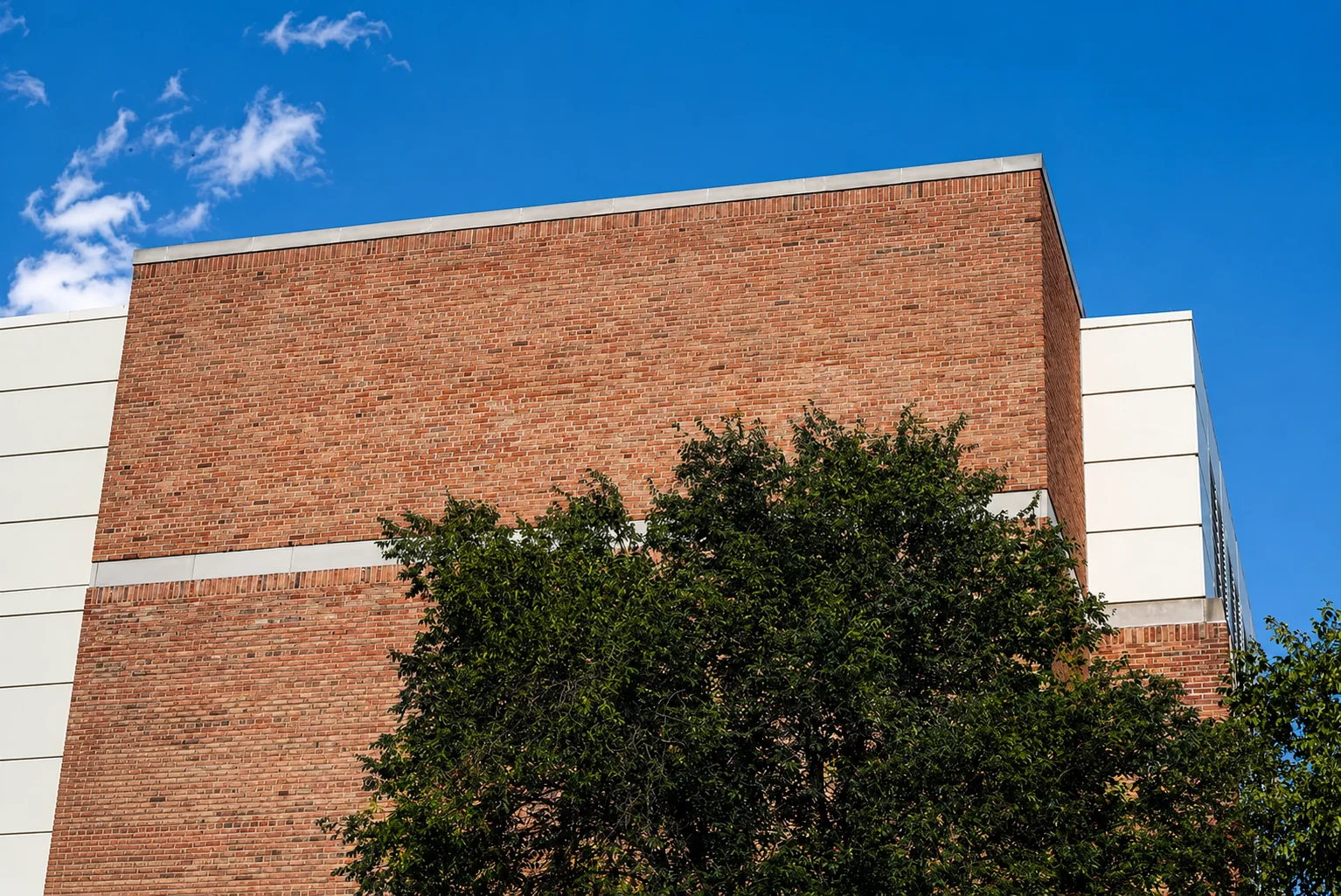
A finished commercial facade, brick courses banded with cast precast. Brick, mortar and precast are all absorbent masonry, which is why a single stain system can hold color across an elevation built from more than one material.
The problem a mixed elevation sets
Most commercial facades are not one material. Brick runs the field, precast or cast stone bands the floors, and a glass return closes the corner. Each of those arrives from a different plant on a different schedule, and each carries its own color tolerance.
The result on site is a wall where nothing is defective and the elevation still does not read as one building. A precast band comes in warmer than the sample. A brick delivery runs a half-shade off the mock-up. Neither is worth tearing out, and neither goes away on its own, because color in fired clay and in cast concrete is not something a wash moves.
Why one system covers the whole wall
The stain is specified for porous masonry, and the spec scope is the whole list a commercial elevation is built from: clay masonry units, block, manufactured stone, natural stone, mortar, and pre-cast concrete. That matters more on a building than on a house. If the brick and the banding took different products, the joint between them would become the thing the eye goes to.
Because it absorbs rather than coats, the finished wall keeps the texture of each material. Precast still reads as precast and brick still reads as brick. The color changes; the surface does not become a film across two substrates that expand at different rates.
How color is set at this scale
Not from a chart. The spec allows up to five color-enhanced loose units for matching, and a field sample of about ten square feet made on the actual surface of the building. On a facade this size that field sample is the approval: it is looked at on the wall, in daylight, at the distance the building is actually seen from, before the rest of the elevation is touched.
Application is by brush, by hand, one masonry unit at a time. The spec is explicit that no spraying or rolling is allowed. On a multi-storey elevation that is the slow part of the job and it is also the reason the finished wall carries the same variation the masonry had, rather than a flat coat laid over it.
What is in this file so far
The photograph is ours and the work is finished. The rest of the record is not written yet. The building, the town, the year it was stained, and the date of the first revisit are being confirmed, and they will be printed here when they are, or they will not be printed at all.
Nothing on this page is estimated. This frame shows a completed facade, which is not the same as a before and an after, and it is not offered as one. The before-and-after set for this project is on the list with the rest of the commercial file.
The full commercial scope is on the commercial page, the specifications and submittal documents are under downloads and spec sheets, and the coverage afterwards is in the lifetime warranty.
Have an Elevation That Does Not Read as One Building?
Send the elevation and the material schedule. We will tell you what a field sample would show.
Request a Quote